

Types of Light Distribution, Road Lighting Luminaire Classification, and Why a Generic Design Doesn't Work for Street Lighting
ARRE —09/10/2026— In public lighting, simply providing light is not enough: the key is to direct light precisely, ensure uniform distribution, and prevent glare and light pollution. To achieve this, it is essential to understand how luminaire optics work and what information a photometric curve provides.
In this module, we explore the different types of light distribution, the classification of road lighting luminaires, and the importance of designing custom optical solutions to meet the specific needs of each street.
What Is a Photometric Curve?
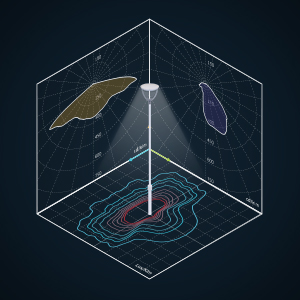
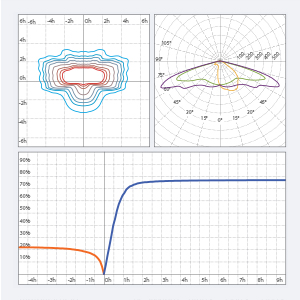
A photometric curve is a two- or three-dimensional graphical representation of how a luminaire distributes light in space. Using a polar coordinate system, this diagram shows the luminous intensity (measured in candelas) emitted at different angles.
By learning to interpret this "light map," lighting designers can determine whether a luminaire concentrates light directly beneath a pole, creating a bright hotspot that causes glare, or projects light over greater distances. This makes it possible to increase the spacing between lighting poles without compromising longitudinal uniformity.
Classification of Light Distribution
Not all streets are the same, and neither is the geometry of light. The relationship between road width and mounting height directly influences the design of the LED optics. Light distributions are therefore classified as follows:
• Type I: Narrow, elongated light distribution. Ideal for luminaires installed along the center of medians or narrow pedestrian pathways.
• Type II and Type III: Medium asymmetric distributions designed for luminaires installed along one side of the road. They direct light forward (across the roadway) and sideways, making them standard solutions for most residential streets and avenues.
• Type IV: Highly asymmetric distribution that projects light significantly forward. Commonly used to illuminate very wide roads or highways from the perimeter, while minimizing light spill toward buildings behind the luminaires.
Glare Control: Cut-off, Semi-cut-off, and Non-cut-off
Beyond determining where light is directed, photometry also defines the critical angles associated with glare. Traditional luminaire classifications distinguish between different levels of light emission near the horizontal plane, where light can shine directly into drivers' eyes:
• Cut-off: The photometric distribution sharply restricts luminous intensity at angles above 80°. These luminaires are essential for minimizing glare on high-speed roads.
• Semi-cut-off: Allow a limited amount of light emission at high angles (with maximum intensity typically occurring between 65° and 75°). They are used when greater spacing between lighting poles is required.
• Non-cut-off: This design does not restrict horizontal light emission. Although it provides a wider light distribution, it can also contribute to increased light pollution.
The ATP Philosophy: Custom Optics
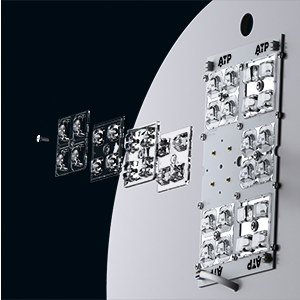
While much of the market offers generic luminaires that require streets to be adapted to their lighting characteristics, at ATP Iluminación, we adapt the luminaire to its environment.
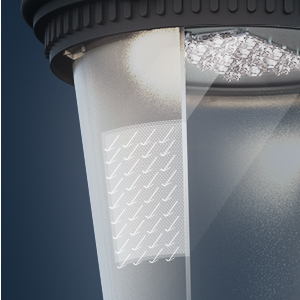
Our R&D team designs custom, high-precision polymer lenses, optimizing light distribution and cut-off characteristics to maximize pole spacing, ensure optimal uniformity, and maintain 0% Upward Hemispherical Flux (UHF).
Press contact:
Nicolás Cancio
ATP Lighting
comunicacion@atpiluminacion.com
Copyright © 2016 ATP Lighting Inc. All rights reserved. ATP Lighting, the ATP Lighting logo and all trade names listed on this website with the ® symbol are registered trademarks of ATP Lighting.


![[...]](https://www.atpiluminacion.com/xtra/imgs/loading.gif)