

Ultra-warm color temperatures, blue light control, and lighting directed only where needed make it possible to combine outdoor lighting with biodiversity protection.
ARRE —25/09/2026— Artificial light is essential to ensure visibility, safety, and the use of outdoor spaces at night. However, when lighting is not properly designed, it can alter natural darkness conditions and affect ecosystems and the species that depend on them.
How does artificial light at night affect animals?
The alternation between light and darkness is a fundamental reference for many living organisms. As we discussed in ATP Campus IX – The impact of light on health and biodiversity: circadian rhythms and CFI, exposure to artificial light at night can alter the natural conditions to which species have adapted.
Some species use natural light to navigate, while others depend on darkness to find food or even to escape predators. Artificial lighting can also interfere with periods of rest, reproduction, migration, and nocturnal activity.
The extent of the impact depends on the type of lighting used, as not all light sources affect wildlife in the same way. This is where factors such as spectral distribution, intensity, the direction of the luminous flux, and exposure time become particularly important.
Reducing the blue light component to protect nocturnal ecosystems
The ultra-warm solutions developed by ATP make it possible to significantly reduce the blue light component. In the case of ATP's 2200 K color temperature, the spectral radiant flux below 440 nm is 1.28%, while with PC Amber it is reduced to just 0.48%.
In natural areas and locations with nocturnal wildlife, this characteristic is particularly important, as preserving natural darkness conditions is a priority.
Wildlife protection across different environments
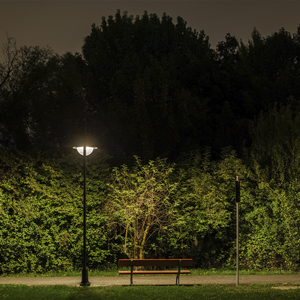
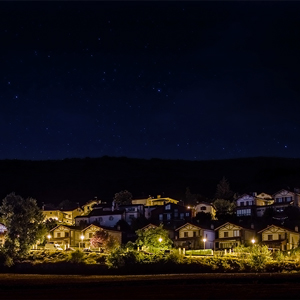
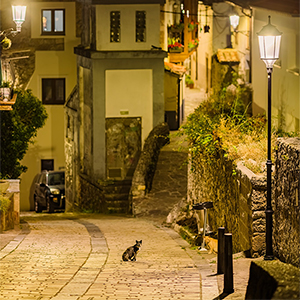
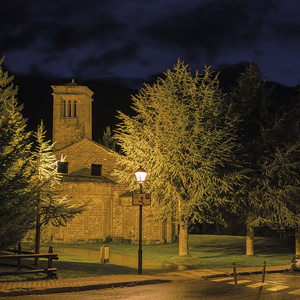
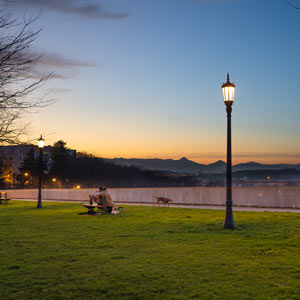
Projects such as Paseo del Arga, Valle de Ollo, and Formigal show how outdoor lighting can be adapted to particularly sensitive natural environments. In these locations, ATP has used PC Amber and ultra-warm 2200 K LED solutions, characterized by their low blue light component, together with optics and lighting levels tailored to the specific requirements of each environment.
These solutions help prevent overlighting and reduce unnecessary light dispersion, thereby minimizing interference with wildlife, their habitats, and natural cycles of darkness.
Towards more wildlife-friendly lighting
Selecting warm and ultra-warm color temperatures, reducing the blue light component, using optics that precisely control light distribution, preventing overlighting, and adapting power levels to the actual needs of each space are all measures that help reduce the impact of artificial lighting on the natural environment.
At ATP Iluminación, we believe that the efficiency of outdoor lighting should not be measured solely in terms of energy consumption. Its ability to integrate into the environment and respect the species that inhabit it must also be taken into account. Responsible lighting means providing the light people need while, at the same time, preserving the darkness that wildlife needs.
Press contact:
Nicolás Cancio
ATP Lighting
comunicacion@atpiluminacion.com
Copyright © 2016 ATP Lighting Inc. All rights reserved. ATP Lighting, the ATP Lighting logo and all trade names listed on this website with the ® symbol are registered trademarks of ATP Lighting.


![[...]](https://www.atpiluminacion.com/xtra/imgs/loading.gif)