

Structural design and non-conductive materials to protect pedestrians, workers, animals, and children in the urban environment
ARRE —09/04/2026— Within the framework of ATP Campus, we are launching a new editorial line designed to support technicians, engineers, and municipal decision-makers in the process of selecting outdoor lighting solutions. This subseries, titled “Decision Factors in Public Lighting,” will address the main criteria that influence a technical purchase: from electrical safety to energy efficiency, maintenance-free durability, and visual comfort.
Each installment will cover a key aspect with a technical yet accessible approach, combining regulations, practical fundamentals, and proven design solutions. Topics will be presented in order of importance. That is why we begin with what should always be the first filter: electrical safety.
Total electrical safety: how to eliminate the risk of electrocution in outdoor lighting
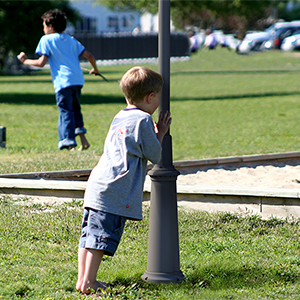
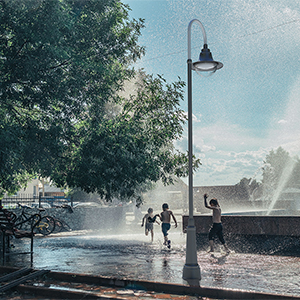
Electrical safety in public lighting remains a real concern. Each year, cases of electrocution are reported due to faulty lighting points, with internal leakages or exposed metal parts. These incidents affect maintenance technicians, pedestrians, animals—especially dogs—and, in particular, children who play in direct contact with streetlights in parks and streets.
Preventing these situations requires a structural approach: non-conductive materials, designs with no accessible metal parts, and dielectric strength far exceeding the minimum required by regulations.
Class II: standards and limits
The international standard IEC 60598-1 establishes several levels of electrical insulation. The most widely used in public lighting is Class II, which requires double insulation without the need for grounding. To certify a product in this category, a minimum dielectric strength of 3,000 volts is required.
What is dielectric strength?
It is the ability of a material to resist the passage of electric current without becoming conductive. The higher this value, the greater the protection against accidental discharges, even in the event of a fault in the system.
Although Class II already implies a high level of safety, its effectiveness over time depends on the overall design and the materials used. If insulation degrades or if metal parts become accessible, the risk of electrocution reappears.
Structural insulation: beyond compliance
Some solutions have gone beyond the limitations of standards by adopting full structural insulation. In other words, not only are internal components protected, but the entire enclosure of the lighting point is non-conductive, from the luminaire to the base.
This approach uses engineered technical polymers as the main material, with a dielectric strength exceeding 22,000 volts—more than seven times the regulatory requirement. This enhanced safety completely eliminates the possibility of electric shock, without relying on grounding or preventive maintenance.
The column: the critical point of contact
The lighting column or pole is the element most prone to physical contact. Unlike the luminaire, which is elevated, the column is within reach of anyone walking by, leaning on it, or playing nearby. It is especially common for children to interact with streetlights during play, without anyone perceiving it as a risk.
It is also common for dogs, during walks, to come into direct contact with the base of columns, especially when urinating on them or sniffing them. In this context, any insulation defect can become a serious incident.
Synergetic Tube®: permanent, maintenance-free insulation
To eliminate this risk at its source, there are solutions such as the Synergetic Tube®, a hybrid structure made of a metal core coated with S7 technical polymer, fully insulating and immune to corrosion.
This coating ensures that the entire accessible surface of the pole is safe to the touch, even under rain, salinity, UV radiation, or environmental pollution. Unlike other systems, it does not require painting, inspections, or surface treatments: the insulation is built into the structural material itself.
Safety you can see
An additional benefit of structurally insulated systems is their visible safety: since they have no exposed metal parts, they visually convey that they are safe elements. This facilitates the work of technicians and installers and reduces the risk of improper handling.
Moreover, when a municipality chooses this type of solution, it demonstrates a genuine commitment to protecting people and the environment, beyond mere regulatory compliance.
Safety for all: people, animals, and children
Preventing electrocution is not just a technical measure—it is a matter of public responsibility. Touching a streetlight should never involve risk, especially for those who cannot anticipate it: children at play, distracted pedestrians, or pets in contact with the base of the pole.
As Guillermo Redrado, Vice President of Operations at ATP Lighting, explains: “The idea that a streetlight could electrocute a person or a dog is inconceivable for ATP Lighting. That is why we manufacture using structurally insulating materials and a design that completely eliminates that risk, without relying on maintenance or grounding.”
Why electrical safety must be the first decision-making criterion
Selecting an outdoor lighting solution involves evaluating multiple factors. But none of them make sense unless safety is guaranteed first. A structurally insulated system eliminates risk at its source, simplifies installation, reduces interventions, and protects the entire community: pedestrians, animals, and children.
In the next installment of this subseries, we will address another key criterion in the technical purchase of lighting systems: maintenance-free durability as a way to optimize public investment and reduce total cost of ownership.
Press contact:
Nicolás Cancio
ATP Lighting
comunicacion@atpiluminacion.com
Copyright © 2016 ATP Lighting Inc. All rights reserved. ATP Lighting, the ATP Lighting logo and all trade names listed on this website with the ® symbol are registered trademarks of ATP Lighting.


![[...]](https://www.atpiluminacion.com/xtra/imgs/loading.gif)