

How the hue and spectral composition of light affect visual comfort, perception, and light pollution
ARRE —20/6/2025— In the previous issue, we discussed the Color Rendering Index (CRI) as a guarantee of visual quality. Today, we turn to another core concept in lighting: correlated color temperature (CCT). This value, commonly expressed in degrees Kelvin (K), goes far beyond simply indicating whether light feels “warm” or “cool.” Its impact ranges from visual atmosphere to the preservation of the night sky.
What is correlated color temperature (CCT)?
Color temperature is a measure of the visual appearance of a light source. The lower the CCT, the warmer and more amber the light; the higher the CCT, the whiter or bluer it appears.
But why is it measured in Kelvin (K), a unit of physical temperature? This scale comes from the behavior of a blackbody radiator: a theoretical object that absorbs all incident radiation and, when heated, emits light with a predictable spectrum.
As this hypothetical body increases in temperature, the light it emits shifts in color—from red to white to blue. Artificial light sources are compared to this model to define their correlated color temperature: not an actual operating temperature, but a reference that describes the perceived tone of the light.
|
CCT (K) |
Approximate visual appearance |
|---|---|
|
1800 K |
Deep amber |
|
2200 K |
Warm white (ultra-warm) |
|
3000 K |
Standard warm white |
|
4000 K |
Neutral white |
This simplified model allows for standardized classification of light sources and facilitates technology comparisons.
Warm light ≠ responsible light
Despite common assumptions, installing warm-colored light sources does not automatically ensure environmentally responsible lighting. The true technical indicator of a luminaire’s environmental impact is its spectral radiant flux, particularly in the range of the most harmful wavelengths: below 440 nm.
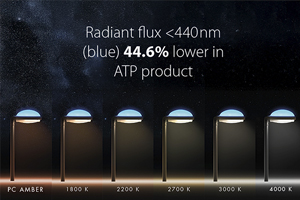
This is where a key parameter comes into play: the percentage of blue spectral emission. It’s essential to understand that two sources with the same CCT can differ by up to 45% in blue content, depending on the manufacturer.
For example, at the same correlated color temperature of 2200 K, an ATP luminaire emits just 1.63% of spectral flux below 440 nm—44.6% less blue emission than the same color temperature from other manufacturers.
Spectral radiance and light pollution
Blue light is the most disruptive for the nighttime environment: it scatters more easily in the atmosphere, alters wildlife circadian rhythms, and hampers astronomical observation. This high dispersion is explained by the physical phenomenon known as Rayleigh scattering, in which shorter wavelengths (like blue) interact much more intensely with air molecules than longer wavelengths, creating diffuse glow that increases skyglow.
That’s why, beyond perceived color, the actual proportion of short-wavelength emission is critical. Choosing a warm CCT is not enough—spectral radiance must be specifically controlled.
As Andrés Armañanzas, director of the Lighting Department at ATP explains: “Color temperature can be a first indicator, but it’s not enough to design truly responsible lighting. Only by analyzing spectral radiance can we ensure rigorous control of light pollution.”
ATP has developed a line of LED products optimized under this technical criterion, minimizing blue emission even in warm and ultra-warm CCT models.
Technical analysis of ATP LED modules:
|
CCT (K) |
Flux < 440 nm |
Flux < 500 nm |
CRI |
|---|---|---|---|
|
PC AMBER |
0.01% |
0.17% |
58 |
|
1800 K |
0.09% |
3.34% |
>70 |
|
2200 K |
1.63% |
7.13% |
>70 |
|
3000 K |
3,93% |
13,81% |
>70 |
|
4000 K |
5.95% |
21.13% |
>70 |
Harmonious and efficient light without sacrificing color fidelity
Advances in LED technology have made it possible to achieve warm color temperatures without sacrificing perception. ATP luminaires combine values as low as 1800 K with CRIs above 70, something unthinkable with traditional sources like sodium vapor (CRI ~25).
This means it's now possible to design warm, inviting, and visually harmonious environments without compromising visual quality or safety.
Choosing data over appearance
In exterior lighting, relying solely on perceived tone is not enough. Two sources with identical color temperature can have very different spectral compositions—and thus, vastly different environmental impacts.
The only rigorous way to assess a luminaire’s true performance is by analyzing its spectral radiance: the distribution of energy emitted across the spectrum, especially in the short-wavelength range. This parameter is critical in evaluating a light source’s potential to cause light pollution, as emissions below 500 nm are the most harmful to the night sky and wildlife.
Responsible lighting design must consider both the apparent tone and the spectral composition. Thanks to current technology, it is now possible to reduce blue content without sacrificing efficiency or color rendering.
At ATP Campus we will continue exploring key technical concepts that help make outdoor lighting more understandable, responsible, and accessible.
Press contact:
Nicolás Cancio
ATP Lighting
comunicacion@atpiluminacion.com
Copyright © 2016 ATP Lighting Inc. All rights reserved. ATP Lighting, the ATP Lighting logo and all trade names listed on this website with the ® symbol are registered trademarks of ATP Lighting.




![[...]](https://www.atpiluminacion.com/xtra/imgs/loading.gif)