

Uniformity, visual comfort, custom design and durability as key foundations for high-performance installations
ARRE —29/8/2025— Energy efficiency, together with safety and durability, is one of the fundamental criteria when making decisions in public lighting projects. It is not just about installing low-power LED luminaires, but about designing a system capable of delivering the right and necessary amount of light with the lowest possible consumption, while ensuring uniformity, visual comfort and sustainability.
More light does not mean better visibility
For decades, efficiency was linked to increasing luminous flux with the lowest wattage. However, this approach is incomplete: high lighting levels combined with poor uniformity do not improve visibility but rather degrade it. The “zebra effect,” with bright stripes alternating with dark patches, causes visual fatigue and may compromise the safety of drivers and pedestrians.
Experience shows that moderate lighting levels, combined with high uniformity, deliver a much more effective result: better perception of space, reduced glare and greater visual comfort. Optimization, therefore, does not mean “more light” but a balanced and homogeneous distribution that allows energy consumption to be reduced without sacrificing safety.
Lighting design and custom manufacturing: the core of energy savings
Each urban or natural environment has its own characteristics: mounting heights, street geometry, pavement materials, vegetation, heritage or traffic density. A standard project can hardly respond precisely to such diversity. Real energy efficiency is only achieved through specific lighting studies that rigorously define the optimal wattage and photometric distribution for each lighting point.
ATP Lighting has its own photometric laboratory and offers lighting studies and 3D renderings that anticipate the actual behavior of the installation. Based on these calculations, ATP manufactures luminaires to specification, adapting optics, wattages and color temperatures to the specific conditions of each project. This level of customization avoids over-lighting, reduces energy use and ensures compliance with regulatory and visual comfort requirements.
Technology that preserves efficiency over time
Energy savings cannot be understood only as an initial figure. For savings to be sustainable, installations must maintain their performance for decades. This is where material reliability and thermal management become critical.
ATP luminaires incorporate precision optics, the Comfort Diffuser® —which eliminates glare without reducing performance or altering photometry— and the Laminar Heatsink®, an innovation that lowers LED operating temperature by 21% and extends service life up to 100,000 hours.
Added to this are housings made entirely of technical polymers S7 and T5, immune to corrosion and anti-electrocution, and inherently resistant to power surges. Thanks to this approach, initial efficiency is preserved over time, avoiding lumen depreciation, premature failures and unnecessary maintenance costs.
Case studies: proven efficiency in different contexts
Theory becomes meaningful when contrasted with real-world results:
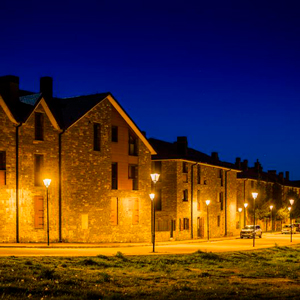
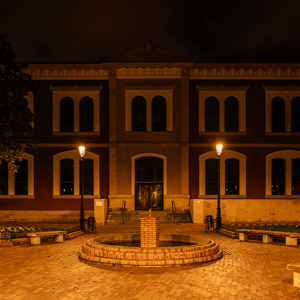
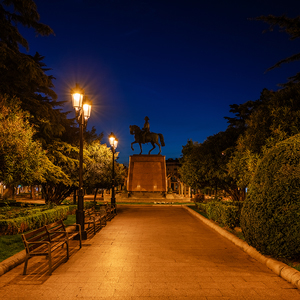
- Logroño (Spain): the renewal of the historic center with Siglo XLA luminaires rated at 19–35 W and customized optics achieved uniformity up to 0.8 and more than 70% energy savings, without over-lighting.
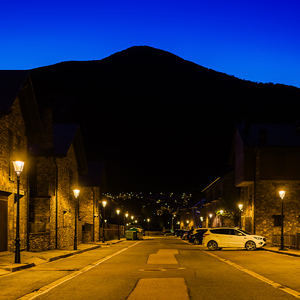
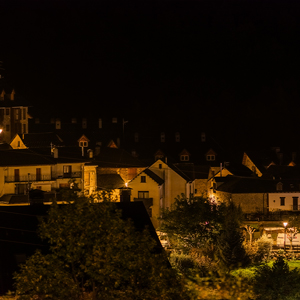
- Villanúa (Spanish Pyrenees): the complete renovation of the town’s lighting system, with over 1,000 ATP LED luminaires at 2200 K manufactured in technical polymers and equipped with Comfort Diffuser®, achieved over 70% savings, high uniformity and a drastic reduction of light pollution. Executed under strict Starlight criteria to preserve the night sky and local biodiversity, the project received an Honorable Mention at the LIT Lighting Design Awards, consolidating Villanúa as a benchmark for sustainable lighting and astro-tourism.
- Escarrilla (Spanish Pyrenees): 209 Villa XLA luminaires of only 35 W were installed, configured with both symmetrical and asymmetrical optics. The result: maximum uniformity, optimal visibility and more than 70% savings, with lighting fully respectful of the mountain environment.
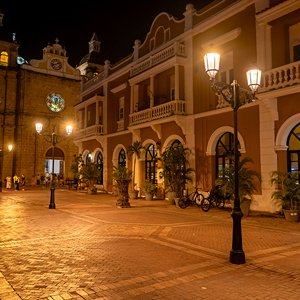
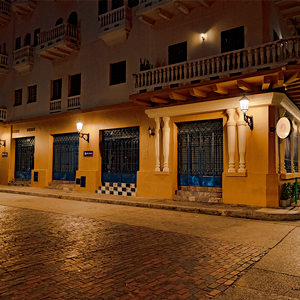
- Cartagena de Indias (Colombia): in the UNESCO World Heritage walled city, the replacement of discharge lamps with ATP LED 2200 K models with Comfort Diffuser® eliminated dark spots, improved uniformity and reduced energy use by more than 70%, while ensuring total corrosion resistance in a demanding coastal environment.
These examples demonstrate that energy efficiency is not just about installed wattage, but about precise, tailored design that combines lighting quality, savings and sustainability.
Efficiency as a strategic decision
For a municipal authority or technical prescriber, choosing efficient luminaires means much more than reducing the electricity bill. It means cutting CO₂ emissions, minimizing light pollution, and ensuring safety and comfort for public space users.
At ATP Lighting we understand efficiency as a strategic decision factor: lighting with intelligence to achieve maximum visual and social performance with minimum energy use. Only in this way is it possible to build more livable, sustainable cities, ready to face the challenges of the future.
Press contact:
Nicolás Cancio
ATP Lighting
comunicacion@atpiluminacion.com
Copyright © 2016 ATP Lighting Inc. All rights reserved. ATP Lighting, the ATP Lighting logo and all trade names listed on this website with the ® symbol are registered trademarks of ATP Lighting.


![[...]](https://www.atpiluminacion.com/xtra/imgs/loading.gif)